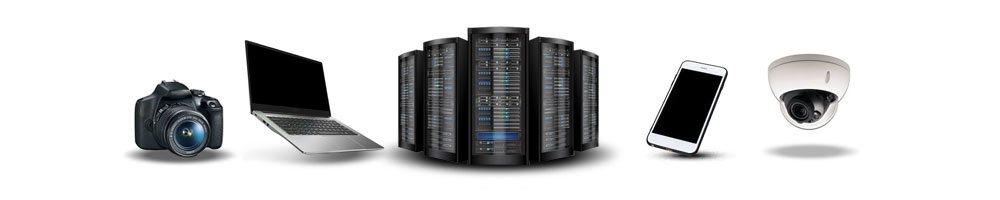
Ontrack data recovery experts can recover data from virtually every operating system and storage device in virtually every data loss situation without voiding equipment warranties.
Understanding Data Loss
Ontrack Data Recovery, Inc. September, 1996
Information Collection Methods
Ontrack engineers in three United States offices collected this information by examining more than 50,000 hard drives and other data storage devices containing data that was inaccessible to users. Using proprietary tools developed over a nine year period, the engineers diagnosed and determined the cause of each data loss situation. These causes have been summarized and grouped into five leading categories, ranked by percentage of occurrence.
Solving the Data Loss Mystery
Data loss is one of computing's most misunderstood concepts. A user is suddenly unable to access a file and is suspended in a state of confusion and panic, wondering, Where did my data go, and how do I get it back? What caused the data loss? What could I have done to prevent it?
This confusion is not surprising. Very little information has been made public about data loss, and the information that does exist is inconsistent. Due to the mixed messages they receive, users find it difficult to properly evaluate their data loss situations and make educated decisions to recover from them.
Ontrack engineers developed this report to take the mystery out of data loss. By examining data loss causes, and offering data loss prevention tips and recovery advice, this report gives users the information they need to adequately assess their data loss situation while maximizing their chances for recovery.
This report refers to lost data as data which has become inaccessible to the user.
Confusion arises because the industry often presents "lost data" as data that has been permanently destroyed, with no hope for recovery. In reality, our findings reveal that approximately 75% of lost data can be retrieved. While data may be inaccessible to users, experts have the ability to recover it using the proper techniques and tools. Unfortunately, hundreds of thousands of gigabytes (GB) of data have been lost simply because users were not aware of their options and gave up hope of recovery.
When creating this report, engineers attempted to determine the root causes of data loss. Because each data loss situation is unique and causes are often interrelated, finding the root cause was sometimes not possible. These findings account for only those causes communicated by users or those that became evident during the recovery process.
For example, a lightning strike may cause a hard drive to suffer electrical failure. If the user is not aware that lightning struck the building, they will be unable to report this to the engineer. They will simply be able to communicate that they are unable to access their data. Except in the most severe cases, an engineering diagnosis will not show that lightning struck the drive. Rather, the cause will be recorded as a drive failure, a hardware malfunction. The root cause may never be known.
Despite technological advances in the reliability of magnetic storage media, the incidence of data loss continues to rise. Data storage remains a fragile science, and data's susceptibility to damage from both natural and human sources remains high.
During the course of this study engineers identified the convergence of three major trends influencing data loss today. These trends represent industry-wide shifts in technology and market behavior.
1) More data is being stored in smaller spaces. Ten years ago hard drives stored 40 megabytes (MB) of data. Today's hard drives store up to 9 gigabytes (GB) on a smaller surface than the drives of a decade ago. Increasing storage capacities amplify the impact of data loss. As more and more data is stored in smaller and denser areas, mechanical precision becomes crucial.
As a part of this advancing technology, the drive tolerance (distance between the read/write head and the platter where data is stored) is steadily decreasing. A slight nudge, a power surge or a contaminant introduced into the drive may cause the head to touch the platter, resulting in a head crash. In some situations, the data residing in the area touched by the head may be permanently destroyed.
The current tolerance on most drives is 1-2 microinches (one millionth of an inch). Comparatively, a speck of dust is 4-8 microinches and a human hair 10 microinches. Contaminants of this size can cause serious data damage.
2) Data has become more mission-critical. Bank account transactions. Hospital patient records. A graduate school thesis. Income tax documentation. New product plans. Automobile engineering designs. Payroll records. Sales transactions.
Users today store data on their desktops and networks that is mission-critical to their organizations and their personal lives. Loss of mission-critical data, by definition, causes major business processes to stop. This, in the worst instance, can cause a company to go bankrupt. System administrators can lose their jobs. Companies can lose faithful customers who lose trust as a result of the company's failure to deliver as promised. The financial, legal and productivity ramifications associated with the loss of critical data puts companies and individuals at great risk.
3) Backup technology and practices have failed to adequately protect data. Most computer users rely on backups and redundant storage technologies as their safety net in the event of data loss. For many users, these backups and storage strategies work as planned. Others, however, are not so lucky. More than 80% of Ontrack's customers back up their data, only to find their backups useless in that crucial moment when they need to restore from them.
Why do these backups and redundant storage systems fail? They fail because the systems are designed with a set of requirements that rely on a combination of technology and human intervention for success. For example, backup systems assume that hardware is in working order; they assume that the user has the time and the technical expertise necessary to perform the backup properly; they assume that the backup tape or cartridge is in working order; and they assume that the backup software is not corrupted.
In reality, hardware can fail. Tapes and cartridges do not always work properly. Backup software can become corrupted. Users accidentally back up corrupted or incorrect information. Backups are not infallible.
What are the Leading Causes of Data Loss?
| Hardware or System Malfunction | 44% |
| Human Error | 32% |
| Software Program Malfunction | 14% |
| Viruses | 7% |
| Natural Disasters | 3% |
Possible Symptoms
Examples
Preventive Measures
Recovery Tips
return to "Leading Causes of Data Loss"
Possible Symptoms
Examples
Preventive Measures
Recovery Tips
return to "Leading Causes of Data Loss"
Possible Symptoms
Examples
Preventive Measures
Recovery Tips
return to "Leading Causes of Data Loss"
Possible Symptoms
Examples
Preventive Measures
Recovery Tips
return to "Leading Causes of Data Loss"
Possible Symptoms
Examples
Preventive Measures
Recovery Tips
return to "Leading Causes of Data Loss"
How does a hard disk drive store data? Hard disk drives store data on one or more metal oxide platters. These platters, which spin at a rate of 3600-7200 revolutions per minute, hold magnetic charges. A read/write head attached to an actuator arm hovers 1-2 microinches (one millionth of an inch) above the surface of the platters. Data flows to an from these heads via electrical connections. Any force that alters this process may cause data loss to occur.
With its proprietary service and software tools, Ontrack is able to provide data protection and recovery solutions that are unmatched in the industry. Ontrack provides a unique "full-service" line of offerings, with its research and development team and data recovery engineering staffs working together to provide the most comprehensive and technically superior data protection and recovery options available.
Ontrack has invested heavily in its research and development efforts. With the rate at which the computer industry is advancing, these efforts are essential to maintaining our leadership position in the market. Ontrack is currently sponsoring a graduate study program at a leading university which is focusing on disk drives and storage-related research, and has plans to add similar programs to its schedule.
Ontrack data recovery services continue to be recognized as the largest and most-highly regarded in the industry. Having performed tens of thousands of successful recoveries on all types of storage devices and all operating systems, Ontrack is the data recovery company other data recovery companies turn to when they cannot recover a customer's data! Ontrack is endorsed by all major hard drive manufacturers and can work on corrupted machines without violating warranties.
For more information about Ontrack data
recovery services and capabilities,
please call Ontrack Japan today at:
| In Japan: 0120-413-374 | ||
| Phone: +81-4-2932-6365 | or | FAX: +81-4-2932-6370 |
| e-mail: sales at ontrack-japan.com | ||
![]()
Japanese
|
Table of Contents
Home
| About Ontrack
| Data Recovery Service
| Technical Support
| Contact Us